📍 Arequipa
Arequipa
Building digital evidence for electric bus deployment
Arequipa is developing a digital monitoring and simulation platform to support evidence-based public transport electrification. By combining GPS-based monitoring of diesel bus operations with a SUMO-based digital twin, the pilot will help operators, municipal teams and decision-makers assess operational performance, energy use, emissions, charging needs and costs before investing in electric buses.
Arequipa at a glance
Arequipa is Peru’s second-largest metropolitan area and relies heavily on road-based public transport. The delayed Sistema Integrado de Transporte (SIT) remains the principal reform for organising and modernising bus operations. Persistent challenges include congestion, fragmented services, ageing diesel fleets, urban air pollution and limited operational data for planning and enforcement.
The city’s Sustainable Urban Mobility Plan 2022–2042, the progressive implementation of the SIT, Promovilidad and GIZ-supported mobility work provide a foundation for the ACCESS pilot’s stronger digital layer.
Why Arequipa?
A strong foundation for digital mobility
Arequipa needs practical evidence to guide bus electrification in a fragmented operating environment where ageing diesel fleets generate emissions and inefficiencies and operational data is not systematically centralised. The pilot creates a controlled way to reproduce current bus operations digitally and test electric-bus scenarios without requiring operators or authorities to purchase an electric bus first.
The work supports implementation of the SIT and the city’s Sustainable Urban Mobility Plan while addressing the need for standardised GPS, operational, financial and service data. It also responds to inclusion needs by establishing a baseline on women’s participation in the operator workforce, working conditions, gender-related conflicts and perceptions of safety. By producing comparable evidence and a transferable decision-support methodology, the pilot can strengthen future data-sharing arrangements, fleet-renewal planning and public-transport oversight.
01
Aboutthe pilot
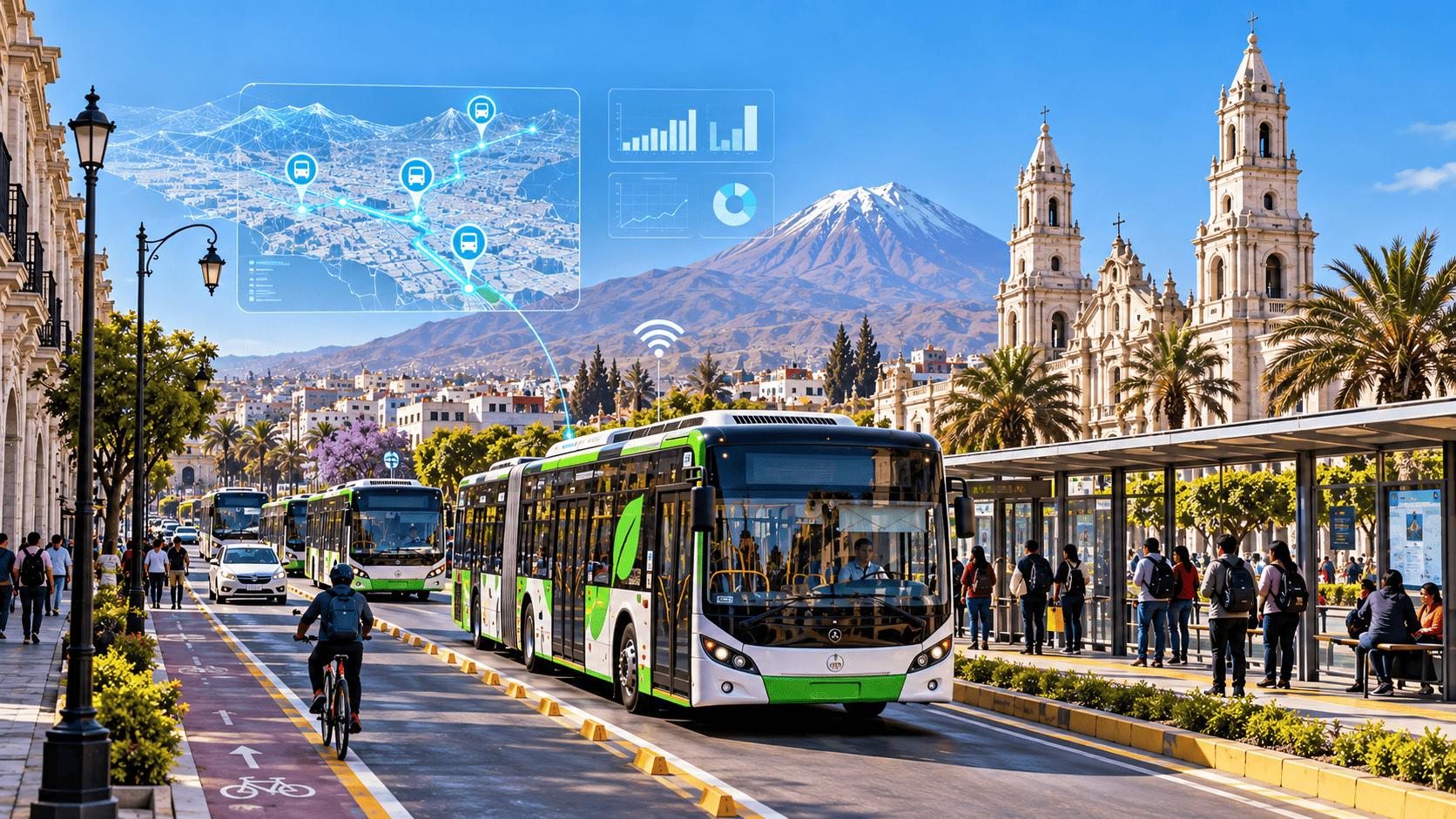
A Digital Twin for Evidence-Based Bus Electrification
The pilot will monitor selected diesel buses on public transport routes in Arequipa using existing operator systems and dedicated GPS devices. It will capture vehicle location, speed, route performance, travel times, service regularity and operating patterns. The data will be processed to build and calibrate a digital twin in SUMO, reproducing observed diesel-bus operations and simulating electric-bus replacement, fleet-renewal, charging, energy, emissions and cost scenarios.
Implementation covers baseline data collection, digital-twin development, analytical tool and dashboard development, iterative adjustment with stakeholders, and technology transfer. Activities run from March 2026 to December 2027. Local partners include the Ministry of the Environment, the Provincial Municipality of Arequipa, Transcayma, COTUM and GIZ, with PUCP leading the technical work and training.
02
At a glance
Challenge
Generating reliable operational evidence for electric-bus deployment while addressing fragmented operator data, uneven digital maturity, ageing diesel fleets and limited public-sector capacity to centralise and use transport information.
Solution
GPS-based monitoring and a calibrated SUMO digital twin that reproduces current diesel-bus operations, tests electrification scenarios, and presents emissions, energy, service, charging and cost indicators through a decision-support tool.
Technology
GPS data collection, operational-data processing pipelines, SUMO traffic simulation and digital-twin modelling, KPI engines, scenario comparison, and an analytical visualisation dashboard.
Avoid
Not a primary strategy for this pilot; scenario analysis may nevertheless help identify inefficient service patterns, unnecessary idling and avoidable empty running.
Shift
Support a shift toward cleaner, more reliable public transport by strengthening the evidence base for electric-bus deployment across Arequipa’s routes and operators.
Improve
Improve the environmental and operational performance of public transport through GPS monitoring, digital-twin simulation and KPI-based planning for fleet renewal, energy use, charging, emissions and costs.
03
Expectedoutcomes
Environmental
An evidence base for reducing greenhouse-gas emissions through more informed and cost-effective electric-bus deployment.
Social
A workforce baseline covering women’s participation, working conditions, gender-related conflicts, perceived safety and harassment incidents, supported by a target of at least 40% women among pilot participants and training for 10 women.
Economic & Operational
Monitoring and scenario comparison of trip frequency, travel time, speed, idle time, kilometres travelled, energy consumption and efficiency, energy and maintenance costs, monthly operating costs, repair costs, implementation cost, payback period and total cost of ownership.
Digital & Innovation
A transferable SUMO-based digital twin and analytical dashboard that turns real-world bus data into comparable electrification scenarios and decision-ready indicators.
Governance / Institutional Frameworks
Practical data-sharing arrangements among operators, the Municipality of Arequipa and the project team, including minimum GPS requirements, collection and transmission protocols, data-quality procedures, KPI definitions and interoperable data structures. The pilot will also generate recommendations for digital reporting by operators and evidence for fleet electrification, emissions reduction and service oversight.
See the pilot on the map
The map shows the selected pilot routes and where ACCESS is supporting bus monitoring, digital-twin modelling and electrification planning in Arequipa.
Interactive overview of ACCESS pilot and mobility focus areas.
What ACCESS will measure
What ACCESS will measure
Arequipa’s monitoring framework covers environmental, operational, financial, social and gender indicators. Measures include CO₂ emissions; trip frequency, average trip time, average speed, idle time, kilometres travelled, energy consumption and efficiency; energy, maintenance, repair and operating costs; implementation cost, payback period and total cost of ownership; and the share of women in the workforce, workplace conflicts, perceived safety and harassment incidents. Baselines currently include 50 trips per day, 60-minute average trip time, 35 km/h average speed, 15 minutes of idle time, 480 kilometres travelled per day, 4.32 kWh/km energy consumption and 86.34 passenger-km/kWh energy efficiency, with remaining baselines and targets to be confirmed during implementation.
Gender and inclusion
Gender and inclusion
The pilot will integrate gender considerations through a diverse internal and consulting team and consultation and validation aligned with the broader Gender Action Plan. It will establish a baseline on women in the workforces of Transcayma and COTUM, including working conditions, gender-related conflicts, perceived safety and workplace harassment. Activities include:
Each pilot includes tailored actions shaped together with local partners. In addition, the ACCESS teams are following the ACCESS Guidelines for Responsible and Inclusive Digitalisation in Transport and are aligning activities with the Gender Action Plan for Argentina and the safeguards for digitalisation in transport. These activities include:
- A target of at least 40% women among pilot participants and training for 10 women in fleet monitoring and platform use.
- Interviews with women working in Transcayma and COTUM operations to assess workplace safety, conditions and gender-related conflicts.
- Inclusive planning measures that use the evidence base to support women’s participation in transport operations and accessible, income-sensitive service planning.
From pilot to scale
Lessons beyond
The Arequipa pilot is designed to expand to all local operators that already use GPS and to encourage adoption among operators that do not. Its methodology can be replicated in other cities where operators can meet common data-sharing requirements. Scale-up will depend on a regulatory framework for sharing data through local authorities, stronger operator engagement, enforcement of GPS integration and sufficient technical capacity. Long-term sustainability is supported by transferring the platform, model files, protocols and training to local authorities.
Download and explore
Explore resources, guidance and learning materials from the Arequipa pilot to support bus electrification, digital transport management, inclusive workplaces and evidence-based planning.
Key statistics and insights from Arequipa.
Download city factsheetSummary of the Arequipa pilot project.
View pilot briefsEvaluation and results from pilot implementation.
View monitoring reportsResources supporting inclusive and gender-responsive mobility.
View gender resourcesGuidelines for responsible data management and digitalisation.
View data guidanceTraining materials, tools and lessons from ACCESS.
Explore learning resourcesPractical steps for scaling and replicating pilot projects.
View replication checklistReady to engage?
Explore resources, guidance and learning materials from the Arequipa pilot to support bus electrification, digital transport management, inclusive workplaces and evidence-based planning.