Medellín
The Aburrá Valley Metropolitan Area is advancing the decarbonisation of its public transport system through ACCESS, piloting digital tools for bus fleet monitoring, route electrification evaluation and sustainable driving training, while also promoting the modal shift toward electric bicycles in delivery services and public transport.
(AMBA)
Modal Share
Use
Pilots
Pilots
Pilots
City Identification
| Country | Colombia |
| City Type | Major Metro |
| Population | 4.2 million |
| Partner Organisation | Technical University from Pereira (UTP) |
| Contact Person | Juan Carlos Castillo Herrera |
| Contact Email | [email protected] |
| Tags |
Overview
The Aburrá Valley Metropolitan Area has an integrated public transport system consisting of the Metro, Metro Cable, Tram, Metroplús and buses, serving over 4.2 million inhabitants. In 2022, the road transport sector emitted 3.5 MtCO₂, of which public transport accounted for 367,800 tCO₂, with buses representing the primary source due to aging engine technologies. ACCESS supports the decarbonisation of the transport system through digital monitoring of bus fleets and electric bicycles, sustainable driving training, and evidence-based tools for route electrification planning.
Mobility Challenges
Traffic Congestion
Growing motorization and high commuter volumes generate congestion across the metropolitan area, increasing transport-related emissions and reducing public transport efficiency.
Transport Emissions
The road transport sector emitted 3.5 MtCO₂ in 2022, with public transport buses representing the primary source due to aging engine technologies and high diesel dependence.
Fleet Decarbonisation
The transition from diesel and NGV buses to electric alternatives requires evidence-based tools to evaluate technical, economic and environmental viability across different routes.
Data Gaps
Limited real-time data on bus operations, energy consumption and emissions restricts evidence-based planning for fleet modernisation and route electrification.
Governance & Coordination
Multiple transport operators, public secretariats and metropolitan authorities require stronger coordination mechanisms to align decarbonisation strategies and data-sharing agreements.
Pilot Design
Digitalization to reduce emissions in freight transport in Bogotá
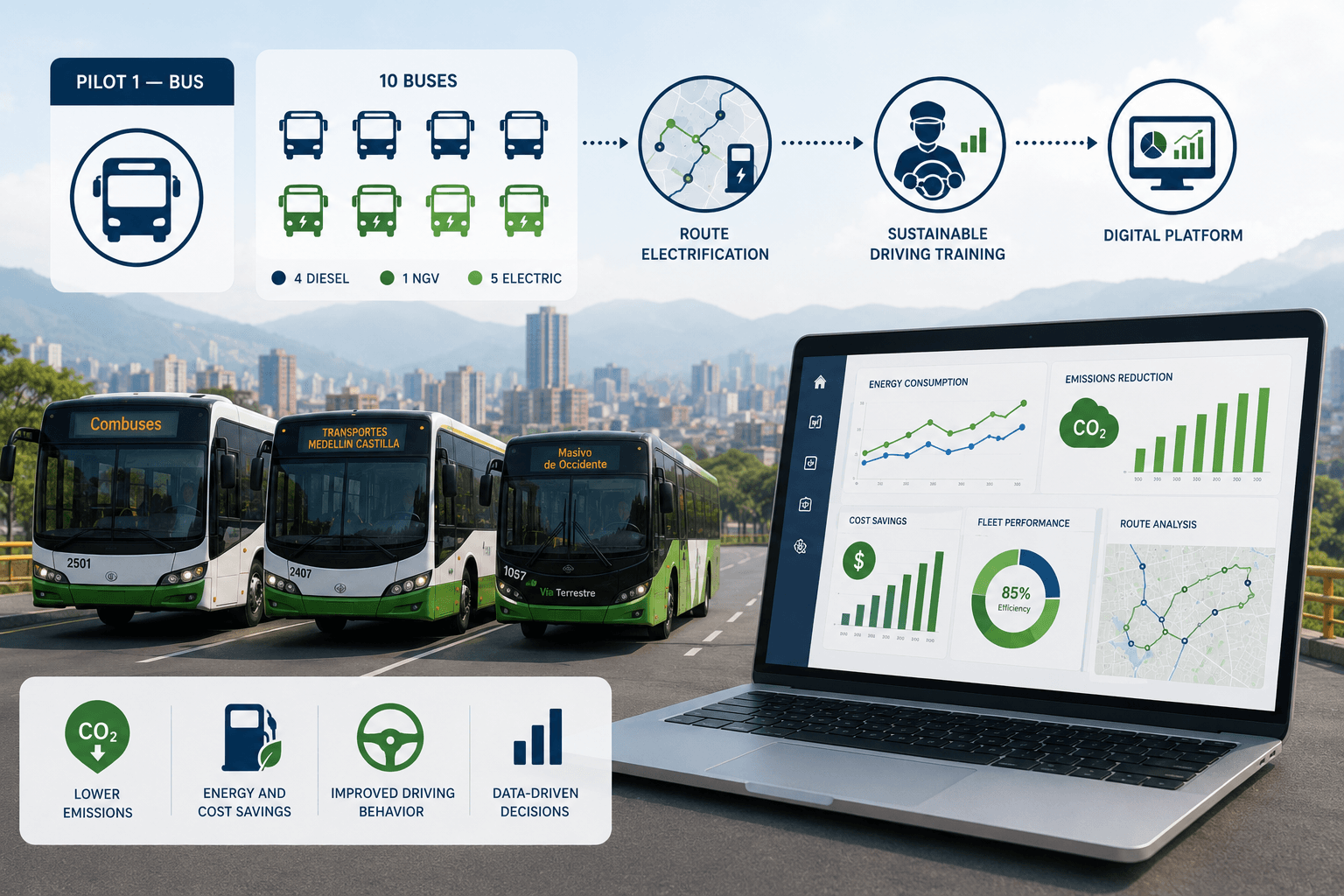
The bus pilot monitors 10 vehicles (4 diesel buses, 1 NGV bus and 5 electric buses) under real-world operating conditions across routes operated by Combuses, Transportes Medellín Castilla, Masivo de Occidente and Vía Terrestre. The pilot applies two ASI strategies: route electrification, which uses digital models to simulate and evaluate the technical, economic and environmental viability of replacing diesel buses with electric alternatives; and sustainable driving training, which delivers personalised coaching to drivers based on monitored behaviour data. Results are visualised through a digital platform that calculates key energy, environmental and financial indicators, enabling evidence-based decision-making for fleet decarbonisation in the Aburrá Valley.
Pilot Description
The pilot monitors 5 ICE buses (4 diesel, 1 NGV) and 5 electric buses across routes operated by Combuses, Transportes Medellín Castilla, Masivo de Occidente and Vía Terrestre. ICE buses shadow electric bus operations to enable direct performance comparisons. Two ASI strategies are applied: route electrification, using digital models to simulate technical and economic viability of replacing diesel buses; and sustainable driving training, delivering personalised coaching based on monitored driving behaviour. Results are visualised through a digital platform calculating key energy, environmental and financial indicators
Implementation Phases
Phase 1 (07–08/2026): Bus monitoring and baseline data collection
Phase 2 (09–12/2026): Route electrification models and sustainable driving training
Phase 3 (01–06/2027): Post-implementation monitoring and evaluation
Phase 4 (07/2027–12/2028): Replication and sustainability
ASI Strategy
SHIFT: Route electrification — digital simulation models to evaluate replacing diesel buses with electric alternatives
IMPROVE: Sustainable driving training — personalised coaching based on telematics data to reduce emissions and fuel consumption
Digital Platforms & Tools
- ACCESS Mobility Data & Analytics Platform
- URL: https://clearenergy.netlify.app/
- Status: In development
Expected Benefits
- Avoided CO₂ emissions from electric bus implementation
- Reduced fuel consumption through sustainable driving
- Evidence for route electrification policy
- Improved operational efficiency
Digitalization to reduce emissions in freight transport in Bogotá
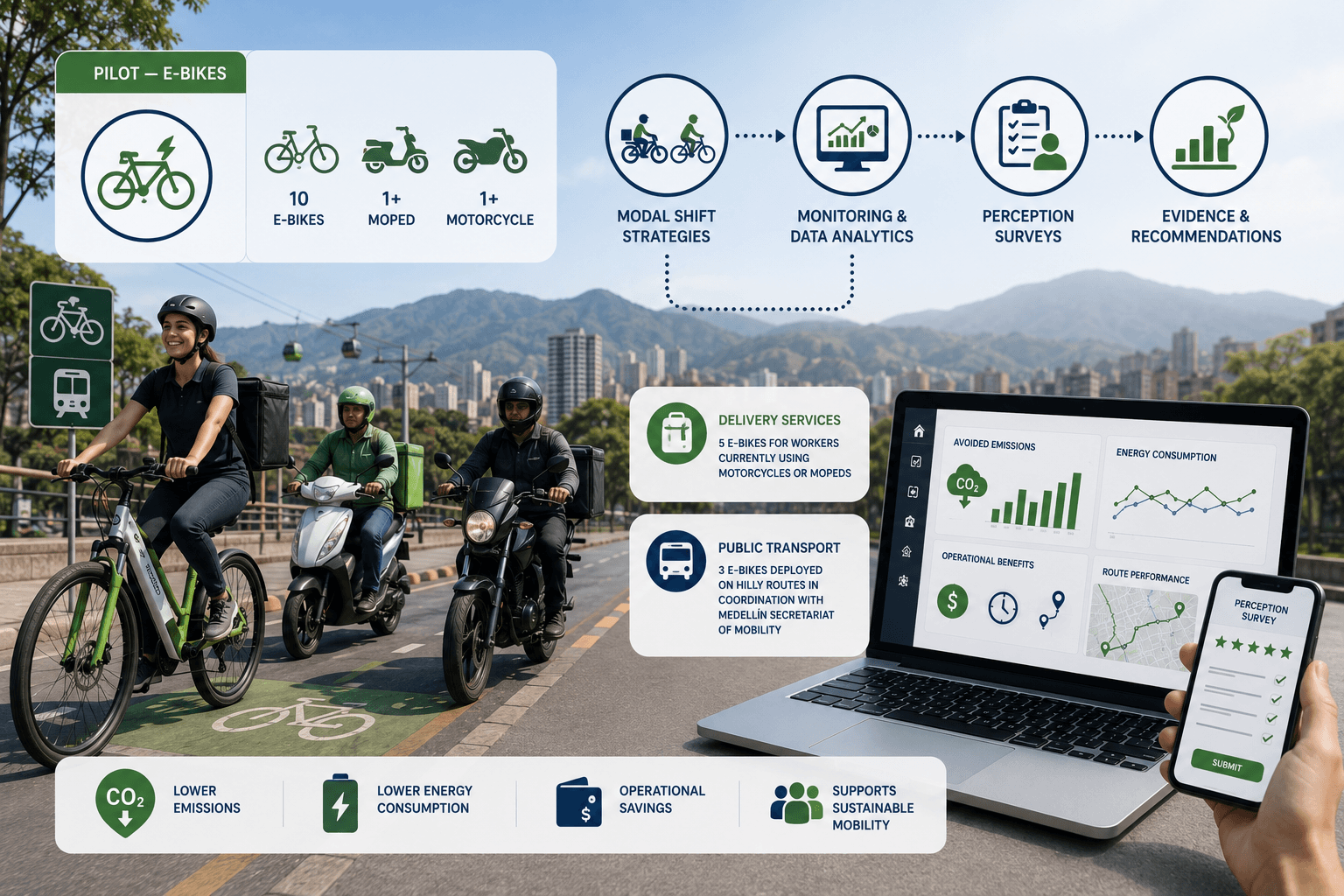
The e-bike pilot monitors 10 electric bicycles, at least 1 motorized bicycle (moped) and 1 motorcycle used for delivery services to evaluate avoided emissions, energy consumption and operational benefits of transitioning from internal combustion vehicles to electric bicycles. The pilot applies two modal shift strategies: in delivery services, 5 e-bikes are made available to workers currently using motorcycles or mopeds; in public transport, 3 e-bikes are deployed on hilly routes in coordination with the Medellín Secretariat of Mobility. Perception surveys and digital platform modules complement the monitoring, generating evidence and recommendations to scale electric bicycle use across the Aburrá Valley and support the EnCicla public bicycle system.
Pilot Description
The pilot monitors 10 electric bicycles, at least 1 motorized bicycle (moped) and 1 motorcycle used for delivery services. Two modal shift strategies are applied: in delivery services, 5 e-bikes are made available to workers currently using motorcycles or mopeds through Runni; in public transport, 3 e-bikes are deployed on hilly routes in coordination with the Medellín Secretariat of Mobility. Perception surveys and digital platform modules complement the monitoring, generating evidence and recommendations to scale electric bicycle use across the Aburrá Valley.
Implementation Phases
Phase 1 (07–08/2026): E-bike monitoring and baseline data collection
Phase 2 (09–12/2026): Modal shift strategies in delivery and public transport
Phase 3 (01–06/2027): Post-implementation analysis and results
Phase 4 (07/2027–12/2028): Replication and EnCicla recommendations
ASI Strategy
SHIFT (Delivery): 5 e-bikes available for modal shift from motorcycles/mopeds to electric bicycles in delivery services
SHIFT (Public Transport): 3 e-bikes deployed on hilly routes to evaluate modal shift within public transport system
Digital Platforms & Tools
- ACCESS Mobility Data & Analytics Platform
- URL: https://clearenergy.netlify.app/
- Status: In development
Expected Benefits
- Avoided CO₂ and pollutant emissions from e-bike adoption
- Evidence for scaling electric bicycle use in delivery and public transport
- Recommendations for EnCicla system expansion
- Improved working conditions for informal delivery workers
Gender & Inclusion Approach
Women Participation
Gender-Sensitive Design
Gender-Disaggregated Data
Accessibility & Inclusion
Implementation Phases
- Environmental Indicators
- Operational Indicators
- Financial Indicators
- Social & Gender Indicators
- Policy & Governance Indicators
Policy Linkages
- Comprehensive Air Quality Management Plan (PIGECA)
- Mobility Master Plan for the Aburrá Valley
- Bicycle Master Plan (PMB)
- Urban Air Protection Zones (ZUAP)
- Sustainable Business Mobility Plan (MES)